International Society for Swimming Fluid Dynamics
Applying RANS, LES, and FSI methods to athlete-specific geometries for measurable drag reduction and underwater phase optimization.
Waukesha, WI
Core Methodology
ISFSFD develops and applies computational fluid dynamics methods to the biomechanics of competitive swimming. The society conducts individualized hydrodynamic analyses using 3D-scanned athlete geometries, resolving flow separation, pressure drag, and boundary layer behavior at swimming-relevant Reynolds numbers (Re ~ 10⁶). Research outputs are translated into athlete-specific and coach-actionable technical prescriptions for underwater phase optimization, push-off mechanics, and equipment selection.
3D structured-light body scans reconstructed into simulation-ready watertight surface meshes. Each athlete's specific morphology—torso curvature, shoulder-to-hip ratio, limb proportions—is resolved for geometry-dependent drag analysis.
Parametric CFD studies across push-off angle, glide depth, and streamline posture. Depth-drag profiles computed via VOF multiphase simulations identify the minimum-drag corridor for each athlete's cross-sectional geometry.
Coupled fluid-structure interaction (FSI) simulations decompose thrust contributions from foot displacement, torso undulation, and added-mass effects. Overset mesh methods resolve hand-entry turbulence interference across stroke cycles.
Boundary layer characterization over racing suit fabrics at swimming Reynolds numbers. Surface roughness effects on laminar-turbulent transition quantified via LES with fabric-specific sand-grain height models derived from optical profilometry.
OpenFOAM, ANSYS Fluent, k-ω SST, Spalart-Allmaras, LES, DDES
8–22M cells, hybrid unstructured, adaptive refinement, overset/chimera
PIV correlation, motion capture (200 fps), recirculating flume measurements
GPU-accelerated HPC, CUDA-based FMM, parallel multi-week simulation runs
Abstracts are publicly available. Full manuscripts and technical reports are accessible to society members.
Flow separation on the human body during underwater glide constitutes a primary source of pressure drag in competitive swimming, yet separation topology varies substantially across individual morphologies. This study presents high-resolution RANS simulations (k-ω SST, Re ≈ 1.2 × 10⁶) conducted on 3D-scanned swimmer geometries reconstructed from structured-light body scans of twelve competitive athletes spanning diverse anthropometric profiles. Simulations were performed in OpenFOAM with hybrid unstructured meshes (8–14 million cells) and validated against particle image velocimetry (PIV) measurements in a recirculating flume. Results identify three consistent separation onset regions—the posterior cervical transition, the lumbar lordosis inflection, and the posterior thigh—with separation point location shifting by 4–11 cm depending on individual torso curvature and shoulder-to-hip ratio. Athletes with higher shoulder-to-hip ratios exhibited delayed separation onset on the upper dorsal surface but earlier separation at the lumbar transition, resulting in a net drag variation of 6–9% across morphotypes at identical glide velocities (1.8 m/s). A morphology-dependent separation susceptibility index is proposed, enabling coaches to identify which athletes benefit most from postural correction versus suit-based intervention.
Full manuscript available to ISFSFD members. Request access
Technical racing suits are engineered to reduce hydrodynamic drag, yet the mechanisms by which fabric surface topology influences boundary layer behavior at swimming-relevant Reynolds numbers (5 × 10⁵ – 2 × 10⁶) remain poorly quantified. This study characterizes boundary layer development over five commercially available competition suit fabrics using large-eddy simulation (LES) on flat-plate and curved-surface domains with surface roughness modeled via equivalent sand-grain height (ks) derived from optical profilometry of fabric samples. Simulations resolve the near-wall region (y⁺ < 1) across fabric-specific roughness distributions ranging from ks = 8 μm (bonded polyurethane panel) to ks = 62 μm (exposed-seam textile). Results indicate that fabric roughness primarily affects the laminar-turbulent transition location rather than the turbulent skin friction coefficient directly. On the anterior torso, where favorable pressure gradients sustain laminar flow over smooth surfaces for 12–18 cm, rougher fabrics trigger transition 4–9 cm earlier, increasing local skin friction by 18–34%. Conversely, on the posterior surface where adverse pressure gradients dominate, early transition modestly delays separation, producing a competing effect on total pressure drag. A net drag penalty of 1.4–3.1% is computed for the roughest fabric relative to the smoothest at 1.6 m/s glide velocity. The study establishes a quantitative framework for suit selection based on individual athlete separation profiles.
Full report available to ISFSFD members. Request access
The wall push-off initiates the underwater phase in competitive swimming, yet optimal push-off angle is conventionally treated as a universal parameter. This study investigates the dependence of optimal push-off angle on individual anthropometric variables through parametric RANS simulations (k-ω SST) over a family of 48 swimmer geometries generated by systematic morphometric variation of a baseline 3D-scanned male athlete (height: 170–195 cm; mass: 62–92 kg; ilio-trochanteric ratio: 0.85–1.05; biacromial breadth: 38–48 cm). Each geometry was simulated at push-off angles from 0° to 15° in 1° increments at initial velocities of 2.0–2.8 m/s, yielding 1,008 individual simulation cases computed on GPU-accelerated HPC infrastructure. The primary performance metric—distance traveled at velocity above 1.5 m/s—shows strong dependence on the interaction between push-off angle and body density distribution. Athletes with higher body density achieve optimal performance at steeper angles due to reduced buoyancy-driven path curvature, while athletes with lower density benefit from shallower angles that exploit buoyant lift to sustain depth within the minimum-drag corridor. Torso length relative to total height emerges as the second-strongest predictor (r² = 0.61) of optimal angle. A regression model relating anthropometric inputs to predicted optimal push-off angle is presented, achieving mean prediction error of 0.8° against full CFD optimization across a validation set of eight additional geometries.
Full manuscript available to ISFSFD members. Request access
The near-wake behind a swimmer in streamline glide produces coherent vortical structures whose spatial extent and dissipation rate have direct implications for drafting benefit and relay exchange positioning. This study employs delayed detached-eddy simulation (DDES) on a 3D-scanned swimmer geometry at Re = 1.4 × 10⁶ to resolve the unsteady wake topology during passive glide at 1.8 m/s. A computational domain of 25 m length with 22 million cells captures wake evolution up to 12 body-lengths downstream. Results reveal a dominant vortex pair shed from the hip-thigh transition with Strouhal number St ≈ 0.19, persisting with measurable velocity deficit (> 5% of freestream) to 4.2 body-lengths downstream. A secondary wake structure originating from shoulder separation dissipates more rapidly (< 2 body-lengths) due to turbulent mixing promoted by upper-body curvature. Simulated drag reduction for a trailing swimmer positioned at 0.5–3.0 body-lengths behind the lead swimmer is quantified across separation distances. The asymmetry of the wake cross-section—wider laterally than vertically due to the human body's cross-sectional geometry—suggests that lateral offset beyond 0.4 m eliminates drafting benefit entirely. These findings provide quantitative guidance for relay exchange timing and open-water tactical positioning.
Full report available to ISFSFD members. Request access
The underwater dolphin kick is the primary propulsive mechanism during the submerged phase, yet the relative contributions of body undulation wave propagation and terminal foot displacement to net thrust remain debated. This study presents a two-way coupled fluid-structure interaction (FSI) simulation of the dolphin kick using an arbitrary Lagrangian-Eulerian (ALE) formulation in OpenFOAM, with body kinematics prescribed from high-speed underwater motion capture (200 fps) of six competitive swimmers. The computational mesh (16 million cells) deforms with the body surface at each timestep (Δt = 0.5 ms), resolving both the pressure-driven thrust from foot deflection and the momentum transfer from the traveling wave propagating along the torso. Results decompose instantaneous thrust into three components: foot paddle thrust, torso undulation wave thrust, and added-mass reaction forces from body acceleration. The torso wave contribution is strongly dependent on wave speed-to-swimming speed ratio (λ); athletes with λ > 1.15 generate positive torso thrust, while those with λ < 1.05 produce net torso drag despite visually similar kick patterns. Kick amplitude at the foot shows diminishing thrust returns beyond ±35 cm from centerline due to flow separation on the dorsal foot surface. An optimal kick amplitude-frequency envelope is proposed as a function of individual limb segment lengths.
Full manuscript available to ISFSFD members. Request access
Swimmers performing underwater glides operate in a depth regime where both free-surface wave-making resistance and pool-bottom ground effect can influence total drag, yet the combined depth-dependent drag profile has not been systematically quantified for realistic swimmer geometries. This study simulates a 3D-scanned swimmer in streamline position at depths ranging from 0.3 m to 2.5 m below the free surface in a 2.0 m deep competition pool domain, using volume-of-fluid (VOF) multiphase RANS simulations (k-ω SST) at velocities of 1.4–2.4 m/s. The free surface is resolved with adaptive mesh refinement (3 million surface cells) to capture wave generation accurately. Results identify three distinct drag regimes: a shallow regime where wave-making resistance contributes significantly to total drag with pronounced Froude number dependence, an intermediate minimum-drag band governed solely by pressure and friction components, and a deep regime where pool-floor proximity produces competing ground-effect and friction changes. The minimum-drag depth band varies depending on athlete cross-sectional area, confirming the need for individualized depth prescriptions. A depth-drag lookup model parameterized by velocity and athlete frontal area is provided for coaching application.
Full report available to ISFSFD members. Request access
Competition swimsuit construction involves bonded, sewn, or welded seam junctions between fabric panels, creating local surface discontinuities whose hydrodynamic impact has not been isolated from bulk fabric effects. This study performs micro-scale RANS simulations (Spalart-Allmaras) over representative seam geometries extracted from micro-CT scans of six racing suits spanning three construction methods: ultrasonic bonding (seam height: 0.2–0.4 mm), flatlock stitching (0.8–1.4 mm), and thermal tape bonding (0.3–0.7 mm). Simulations at swimming-relevant local Reynolds numbers (Reₓ = 10⁵–10⁶) resolve the boundary layer perturbation, local separation bubble formation, and turbulence generation at each seam type. Flatlock seams produce local separation bubbles extending 8–14 mm downstream, with turbulence intensity elevated significantly relative to the undisturbed boundary layer. Seam orientation relative to the local flow direction is found to be as important as seam height: transverse seams generate 2.4× the drag perturbation of flow-aligned seams of identical geometry. Optimal seam routing maps based on body-surface streamline patterns are presented.
Full manuscript available to ISFSFD members. Request access
The hand and forearm entry into water during freestyle recovery generates a transient disturbance field that interacts with the oncoming flow, potentially increasing drag on the leading arm and torso during the subsequent catch phase. This study employs unsteady RANS simulation with overset (chimera) mesh methodology to model the entry phase of freestyle stroke with realistic limb kinematics extracted from motion capture of four competitive swimmers. The overset approach allows the arm geometry to move through a stationary background mesh (12 million cells) without mesh deformation artifacts. Results quantify the entry splash as a localized turbulence injection event, with turbulence kinetic energy (TKE) decaying to background levels within 0.3–0.5 s depending on entry angle and velocity. The critical finding is that the residual turbulence field from entry interacts with the opposite arm's catch phase: at higher stroke rates, the catch arm encounters entry-generated turbulence that reduces its effective angle of attack, decreasing catch-phase propulsive force. An optimal entry angle-stroke rate coupling is identified that minimizes this inter-arm turbulence interference, providing stroke-rate-specific technique prescriptions.
Full report available to ISFSFD members. Request access
Competition pool water temperatures (25–28°C per FINA regulations) produce kinematic viscosity variations of approximately 8%, yet the performance implications of this viscosity range on swimmer drag have not been isolated through controlled computational analysis. This study simulates a 3D-scanned swimmer in streamline glide at water temperatures of 24°C, 26°C, 28°C, and 30°C using temperature-dependent fluid properties in a conjugate heat transfer RANS framework. The swimmer body surface is modeled as a constant-temperature boundary (skin temperature 33°C), generating a thin thermal boundary layer that modifies local viscosity in the near-wall region. Total drag decreases monotonically with increasing temperature, driven primarily by reduced skin friction as viscous sublayer thickness increases with lower viscosity. The thermal boundary layer—a warm, lower-viscosity envelope surrounding the body—contributes additional drag reduction beyond isothermal predictions by locally reducing near-wall shear stress. The study provides correction factors for normalizing performance data across pool temperature conditions, enabling fair comparison of CFD predictions validated at different facilities.
Full manuscript available to ISFSFD members. Request access
Full RANS or LES simulations of swimmer hydrodynamics require multi-week HPC computation per athlete configuration, limiting practical application to pre-competition analysis cycles. This study investigates GPU-accelerated vortex element methods (VEM) as a reduced-order alternative capable of near-real-time drag estimation. The approach discretizes the swimmer's vorticity field into Lagrangian vortex particles, with particle-particle interactions accelerated via the fast multipole method (FMM) on NVIDIA GPU architecture using CUDA. The FMM reduces computational complexity from O(N²) to O(N log N), enabling simulations with 10⁵–10⁶ vortex particles to complete in minutes on a single workstation GPU. The method is benchmarked against full OpenFOAM RANS solutions for a 3D-scanned swimmer in streamline glide at Re = 1.2 × 10⁶. Flow separation location prediction achieves ±2 cm accuracy on the dorsal surface. The VEM approach enables same-day parametric studies—testing multiple push-off angle and depth combinations within a single training session—representing a practical pathway toward field-deployable CFD coaching tools that maintain physics-based rigor while meeting competitive training time constraints.
Full report available to ISFSFD members. Request access
Founder & Principal Investigator
CFD Engineer · Pan American Games Medalist
RANS simulation outputs for swimmer hydrodynamics during passive glide phase at Re ≈ 1.2 × 10⁶
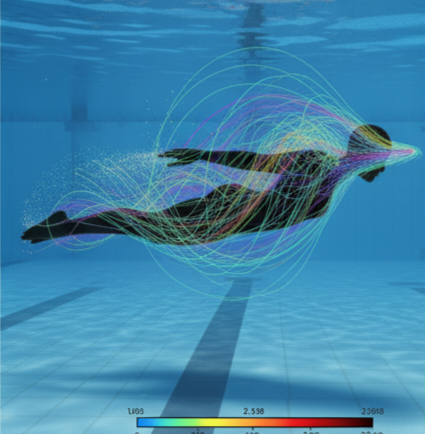
Flow acceleration and recirculation zones near head, torso, and feet. Color field: velocity magnitude (m/s).
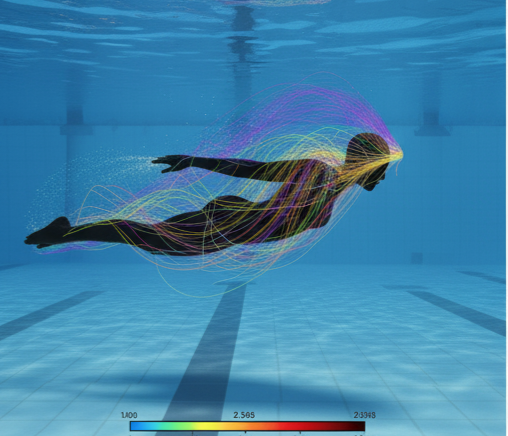
Velocity magnitude contours on swimmer body surface. High-velocity / low-pressure regions indicated in red.
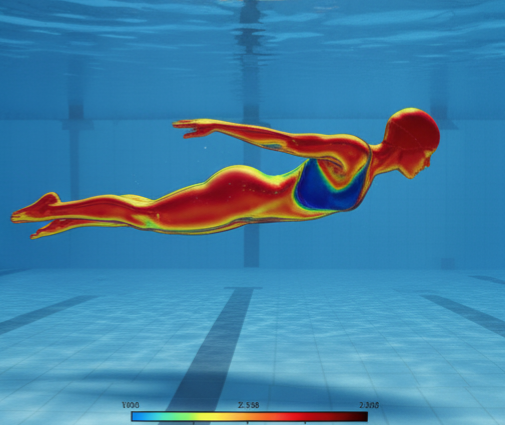
Side-view showing wake formation behind torso and thighs. Flow separation and primary drag sources visible.
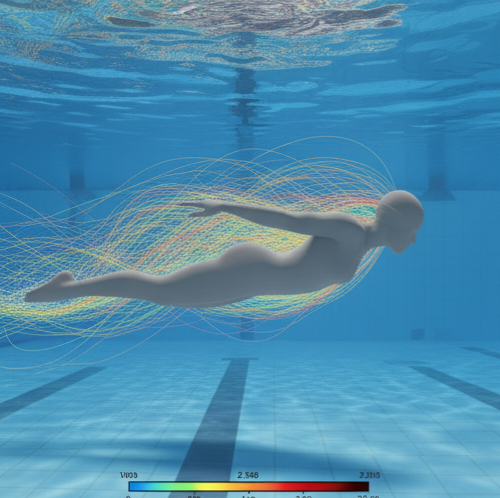
Semi-transparent geometry showing laminar attachment along head/upper torso and downstream wake dissipation.
ISFSFD is open to collaboration with research institutions, sports science laboratories, national swimming federations, and CFD research groups.